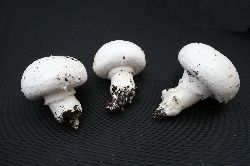
Growing Mushrooms
There are many types of fungi in the UK. Perhaps of all of these, we are all most familiar with the common mushroom (Agaricus campestris). But instead of buying mushrooms in the shops, why not try growing your own with a mushroom kit. This is great fun, you learn a lot about fungi and soils - and you can safely eat the results; what could be better!
 An important safety note is that although many wild fungi are edible, some are horribly poisonous. So never, ever eat wild fungi unless you are advised to by a very experienced mycologist (fungus expert)! Below you can see the results of a kit that you can buy in any garden centre.
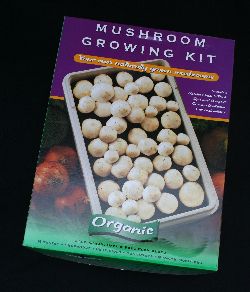
You can easily purchase mushroom kits in most garden centres. They come as a self-contained pack complete with everything you need to grow mushrooms packaged up and ready to go. These bags contain the fungal spores and peat.
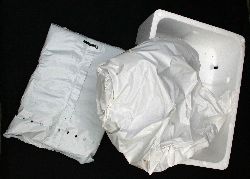 The kit is usually supplied in a polystyrene box which is used as the container. The first task is to open the fungal spores bag and place the contents into the box.
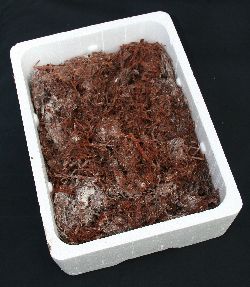
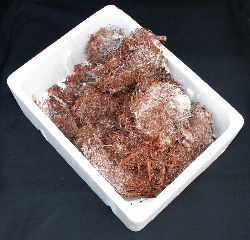 The mixture here is a straw mulch which has been dosed with the spores of the mushroom. Kept warm, the tiny wisp-like threads, the mycelium, of the fungus quickly spread throughout the mixture.
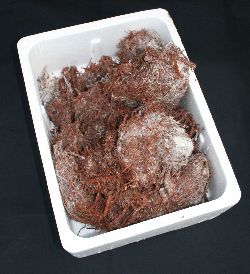 This spreading of the mycelia is exacly what happens in the wood of fallen trees and other organic matter (such as the BODIES of dead creatures!) The threads are in fact the 'body' of the fungus and end-to-end would measure many kilometres in length.
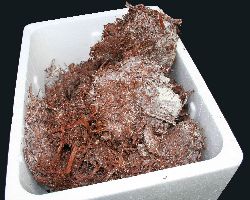
Normally, we only see the 'above ground' part of fungus. A mushroom is a fruiting body extending from the main complex of mycelia. What goes on underground is far, far more extensive. This is easy to see in these photos, but next time you are in the woods, find an old rotten tree and pull back a section of the rotting bark. Behind you will no doubt find the tiny strands of fungi growing there. Remember there are many, many different species of fungi.
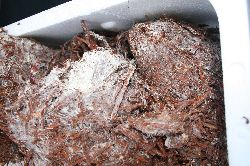
How many individual fungal bodies are there in this picture? Impossible to say, but there will be a very great number. However, a single fungus can grow to an enormous size. A single fungus in Washington, USA was recorded as being over 6km2 in size - that is BIG! Bet you thought the whale was the biggest organism on earth - no, it is the humble fungus.
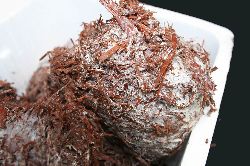
Back to the story now! We spread out the spore/straw mixture evenly over the bottom of the container being as careful as possible not to crush the delicate mycelia.
Once the mixture is spread out, it must be covered over with a rich peat soil (better if it isn't real peat as is mentioned elsewhere on Soil-Net!) This soil will give the mushrooms a firm foundation for their growth, and will retain moisture to sustain their development. In this way the fungus benefits from the soil in much the same way as a green-leaved plant does. Keep a little of the soil back for later use. Why? All will be revealed!
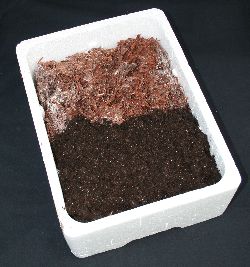
Ensure the soil is evenly spread over the surface and patted down into place gently, leaving a gap between the surface and the top of the container - you need to ensure a good air flow into the container.
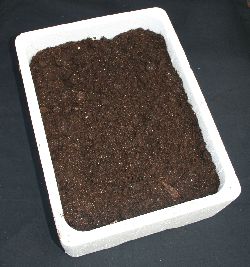 The next thing to do is to water the mixture liberally, with 1-2 litres of clean water. This should ideally be applied by a mister or a spray, again to avoid a deluge of water damaging the tiny thread-like mycelia.
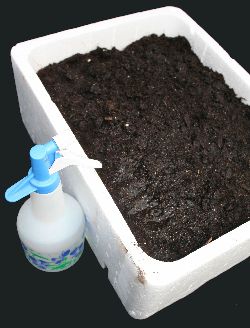
Be sure to water evenly across the mixture, the centre and all edges. Let the water soak in. It is best to mention at this point that you should have put the box on a tray to prevent spills! Now they tell you! OK the photo doesn't show the tray - but this is necessary.
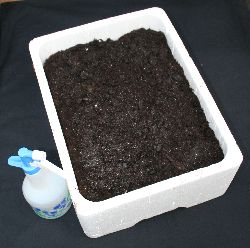
Cover the container over with a loose cover. Here, the carboard sleeve is made into a lid; you can equally use an old tea towel. The key is to allow for a good air flow. Now wash your hands. That's it you've finished - you can now place the mixture in a warm dark place. It's no use placing the container in a freezing cold garage if you want the best crop of mushrooms. Ideally, keep the box somewhere where there is a bit of warmth (but not too hot though). In France, many commercial shop-bought mushrooms are grown in deep, dark caves dug into the rock where the air is still and humid - perfect conditions! Failing that, try under the stairs. The container must be inspected now every few days and watered (again gently with the water spray) as required.
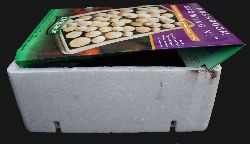
After about four weeks of care, if you are lucky strange white pinheads start to appear in the soil. These quickly swell and grow. Unmistakeable mushrooms budding.
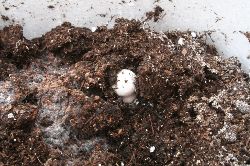 These emergent mushrooms will quickly grow and develop into fine clumps of big mushrooms - wonderful! Be ready to pick them when they are about the size you see them in the shops.
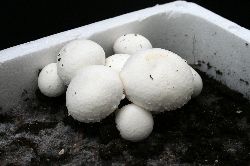
Hopefully clumps will be springing up all over the mixture. When they are ready you can pick them. Again remembering the fine threads beneath, the best way to pick mushrooms is to twist them to break them off. This causes the least disturbance and is far better than just tugging them out. Taking out the mushrooms leaves a cavity in the soil. This is where that left-over peat can come in - sprinkle a little of this soil into the holes and water again. The mushroom is, as noted, the fruiting body of the fungus. As the mushroom matures it spreads out like an umbrella and the 'gills' open dropping new spores to the soil. The gills are arranged rather like the spokes on a bicycle wheel. It is best to pick the mushroom before it reaches this mature stage.
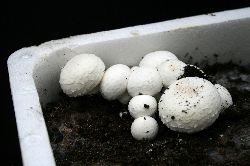 This is a first crop of mushrooms, and they are ready after only a few weeks. Once you have harvested the mushrooms, don't forget that there is more to come. Keep watering and tending the mixture and after a week or so you will have another, then another crop and so on. It is likely that each time there will be slightly less mushrooms. Why is that? This is an interesting question and one which relates to discussions on Soil-Net about the nutrient cycle. The soil contains nutrients, the food, for the mushrooms. As the mushrooms grow and are removed, so too is the 'goodness' in the soil mixture. Guess where this ends up ... as they say 'you are what you eat'! Eventually the soil nutrients are exhausted and the mushrooms and fungus will wither away. Plants do this too in the soil - which is why farmers need to add fertilisers to replenish the soil for their crops year after year. It is also why you might find 'fairy rings' of fungi growing in the wild. Imagine one mushroom, grown to maturity and dropping spores in a ring around itself. The mushroom will have extracted the nutrients from the soil under it. The spores around will develop themselves into mushrooms and also drop spores all around them. Within the centre, the soil is exhausted, but beyond the soil is still fertile and so the ring expands and expands. Look out for these characteristic rings in the woods and fields. Can science explain everything? Hmmm, well perhaps it really is where the fairies dance in the full moon!
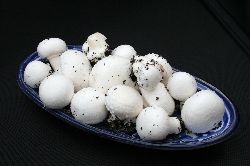
Take the opportunity to inspect the mushooms closely, as you prepare them for your tea! Note the stem and the connections to the mycelia, note the cap and the emergent gills beneath. Cutting a mushroom in half lengthways will reveal this well. Perfect on toast too - enjoy!