
Altering the landscape
Whenever roads, railways and canals have been built, a major consideration has been the landscape through which it must pass. The same is true with modern networks today. Very few parts of the country were so flat that they did not need some way to level out the high ground and fill in the hollows. How was this done?
Roads
In prehistoric times tracks developed with minimal alteration of the natural terrain. In fact early peoples often preferred to travel along ridges where they were safer from the dangers which lurked in the wooded valleys below. The Romans undertook to move considerable amounts of soil when it seemed appropriate, for example by building roads on embankments to cross marshy land.Canals
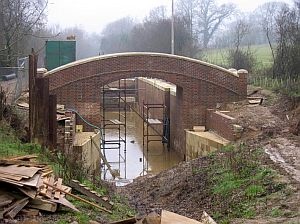 Roads, however, tended to go around steep hills rather than over the top. It was a different problem when our major canal network was built in the late eighteenth century. Firstly, the construction of canals required the removal of vast amounts of soil. This was done by groups of building workers known as 'Navvies', who travelled the country working on canal projects. The cutting was dug wider and deeper than the required size, then lined with a thick layer of 'puddled' clay, a mixture of clay sand and water, which formed an impervious layer on the base and sides. Since the water needed to flow with a gentle gradient, various ways were developed to overcome problems caused by the landscape through which the canal ran. Tunnels were cut through hillsides and most canals had a number of locks which raised the boats from one level to another. Sometimes an aqueduct would be built across a steep valley.
Railways
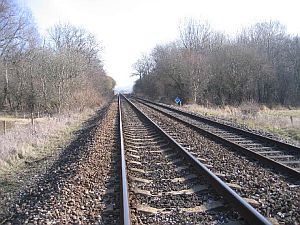 Railways faced similar problems. Again the groups of Navvies were employed to dig out and lay the tracks, and massive quantities of soil had to be removed from some areas and used to fill in others. In many areas our railways run through deep cuttings, all of which had to be dug out by the workmen. Elsewhere the track lies along embankments, across viaducts and through tunnels.
Motorways
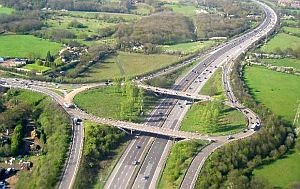 Until modern times roads altered the landscape much less than canals and railways had, but with the construction of our motorway network in the twentieth century the effects are much greater. With modern machinery hills are no longer a problem and vast quantities of soil are moved during construction. Massive road cuttings can be cut relatively quickly and, in spite of the financial cost, road tunnels are also created in some places. Another problem with motorways is the acreage of soil covered (or 'sealed') by tarmac and thus unusable. This is particularly evident at intersections.
Airports
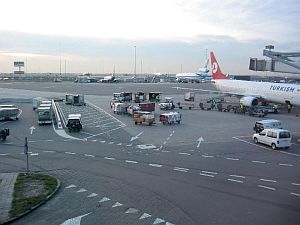 Airports provide different problems for the soil. The site of a new airport will be chosen for the relative flatness of the land in that area but the acreage involved can be vast, to accommodate the huge aeroplanes of today. Much of this land will be buried under concrete, both for the network of runways and for the terminal buildings and many other office blocks and hotels associated with the airport. Most of our airports are being enlarged with extra runways being built, thus increasing this problem.