
A dry lake and dry rivers
This case study is about a dry lakebed with rivers which go nowhere, on the Konya plain in the south of the Republic of Turkey.
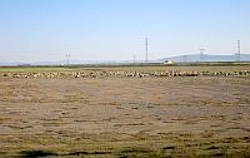 The Konya plain in southern central Turkey was once a vast dry inland lakebed. This dried up around 25,000 years ago, just after the period of the last Ice Age in northern Europe, when evaporation led to the disappearance of the lake. This left an absolutely flat plain coated with a surface of marl. There was no ice in this area, but climate changes since then mean that this is now the driest part of Turkey and for centuries the plain has been dry and arid, suitable only for herding flocks of sheep.
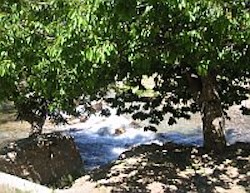 The original lake was fed by a number of rivers which still flow on to the plain from the surrounding hills and mountains. The river water fans out onto the plain, where it is absorbed by the dry soil and quickly ceases to flow. The result is a number of fertile fans of alluvium which have formed on the edges of the plain. Here the soil has sufficient moisture to allow the growth of crops and even trees, and it is in these places that settlements such as Konya, Ivris and Cymra have grown up. The contrast between the alluvial fans and the surrounding plain where there is no water, is immediately obvious and the land use changes from crops to shrubs almost instantaneously.
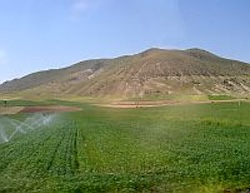 In the last five years or so, however, there have been great changes on parts of the Konya plain. Irrigation has been introduced very widely, using the water from these rivers, and now there are many crops growing on what was, until recently, land only marginally useable for farming. It is clear that, given water, the soil is fertile. However, the irrigation is causing the depth of the ground water to fall by two metres a year.
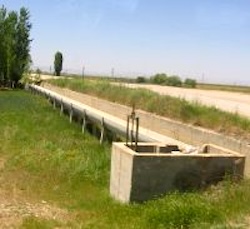 This is partly due to many farmers boring their own wells for irrigation and also because the rainfall is decreasing with climate change so that the river flows are reducing. In view of the great heat in summer, evaporation is a major problem from all the irrigation channels. One wonders what the long-term future of this area will be.