
Pores and soil water
In addition to the mineral grains and organic matter which form the main solid constituents of the soil, pore space is vital component in developing the architectural structure of the soil. Good soils need plenty of pores. The best soil structures tend to be in the topsoils. This is mainly because there is usually organic matter present and this attracts huge numbers of organisms which work to decompose it. The organisms ingest the soil , create small structural units and numerous burrows in the soil. Crumb and granular structures formed in this way are ideal topsoil structures for farmers and gardeners because they contain plenty of pores through which air and water can circulate readily, and through which plant roots can readily move in search of air, water and nutrients.
 Usually with depth, the soil structural units get larger as there is less of the influence of organic matter and organisms, and here the structures relate more to the texture of the soil and the water regime. Whereas the granular and crumb structural units tend to be small, deeper down particularly in clay soils there will be much larger structural units, often several centimetres in size. There are several types of structure in soils depending on factors such are texture, organic matter content and depth.
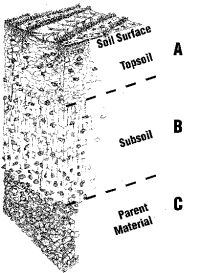
A vertical slice of this skin taken down into the soil at any place on the landscape will reveal a soil profile. The soil profile is defined as a vertical section of the soil from the surface vertically down through the soil until the underlying rock or sediment is reached.The soil profile is an important concept because it forms the basis for classifying soils and giving them distinguishing names (like flowers and animals are classified and have names).
Water is a very important component of soils and plays a huge part in the way soils behave and in the ease with which they can be worked for agriculture and other uses. Soils vary in their water holding capacity. Water is held in the soil around particles and the edges of pores. It is held in these positions with various degrees of strength. Sandy soils tend to hold little water whereas clay soils can hold much water though some of it will be unavailable because it is held strongly in tiny pores. The drier the soil becomes, generally the stronger the soil will hold onto its water. Soil water is essential for the survival and growth of plants and for maintaining soil organisms.