
Soil profiles
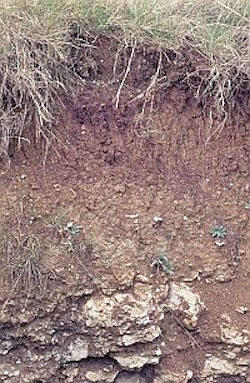
The soil profile is a vertical section taken from the surface of the soil down to the bedrock below, or to a depth when one is clearly in geological sediment rather that soil. When you see the full soil profile exposed you should be able to see all its soil horizons. It is the nature and appearance of the profile which holds the key to how soils are classified. It is a pity that the profile of most soils remains out of sight and special steps, such as excavating a pit or seeking places where the soil is exposed, need to be followed to reveal the exciting world of soil profiles. When next you see a roadside cutting where the soil depth is exposed do look at the soil profile and see how it is formed and the various horizons that make it up.
Soil profiles and the horizons of which they are composed hold the key to soil classification. Every profile is unique, just as the appearance of every human being is unique. What we look for in classification is the grouping together of soils that have been formed by similar processes and often from similar materials. By the appearance of the soil depth we can interpret the processes that have taken place to form the soil and begin to group soils that have a similar history of development.
There have been many attempts to classify the soils both of a single country and also of the whole world. Some of these classifications are complex and require an advanced understanding of soil development and processes leading to their formation. For purposes of introducing you to soil classification in Soil-Net.com we take a simple approach, introducing you to the main soils and their nature and properties. To help you with this we are introducing a number of (virtual) soil walks where you will be able to see some of the different soils. This should be a good starting point and help you to identify some of the soils around you in the countryside.