
Nutrient pollution
There is no doubt that world food supply is heavily dependent on the use of fertilisers. Soil nutrients are removed from the field annually in the harvesting of crops. If these nutrients were not replaced then yields would decline and it is unlikely that we should be able to feed the world population. Therefore the addition of fertilisers to farmed soils is essential. There is, however, concern that of much of the fertiliser added annually to the soil less than 50 percent of the nutrients it contains are actually used by the crop for which they were intended. The remainder in the soil is then subject to several possible fates, including leaching out into the groundwater below.
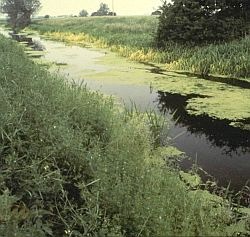
A problem that has arisen since the large additions of strongly nitrogen based fertilisers in the last few decades is that much of the nitrogen not used by the crop has been leached out of the soil, down into the groundwater and in some cases out to the lakes and rivers. Nitrate is very mobile in the soil and is readily taken up by water in the soil and moved out of the soil system into water bodies. These water bodies, which are sinks for nitrogen, are often responsible for providing the water supply for humans and animals. In many parts of Europe there has been a significant rise in the levels of nitrates in the drinking water supplies and this has been linked to the high applications of nitrogen fertiliser that have been applied to many soils. High levels of nitrates can be toxic to very young children and have also been linked with gastric cancer. This problem has led to governments establishing Nitrate Sensitive Areas in which farmers are restricted in the amounts of nitrogenous fertiliser that can be applied. Another major problem associated with this mobile nitrogen is that when it gets into water bodies it can cause eutrophication and death to aquatic life.
As well as nitrogen, other components of fertilisers can cause problems in the wider community. For example, phosphorus added in fertiliser to the soil has been strongly linked with the eutrophication of lakes, streams and rivers. If too many nutrients enter the water bodies, some of which may be poisonous, it leads to very prolific growth of aquatic plant life, and can cause problems to fish in terms of diet and environment. Soils containing phosphorus added as fertiliser may be subject to erosion and the eroded sediments containing the phosphorus can be transferred into the water courses. To reduce the risk of this, efforts need to be made to minimise soil erosion. Eroded materials reaching the watercourses will add a range of nutrients to the water bodies, many of which may be surplus to their requirements, and upset the existing aquatic environment.