
Effects of salinity
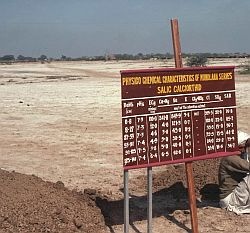
Salinity affects the soil in a number of ways. Firstly it can have a direct effect on the health of plants. There are a few plants, termed halophytes, that can tolerate high quantities of salts but most plants grow less effectively in a saline environment. One of the most important factors is the water supply for plants. Under normal, less extreme soil conditions, plants take in water from the soil. However, when the salt concentration in the soil is greater than that in the plant, as it can be in many saline soils, there can be a reverse movement of water from the plant to the soil, thus impeding normal water uptake by the plant.
When the pH of soils is high, i.e. greater than pH 7.5, and particularly in those soils rich in sodium, the solubility of many of the essential nutrients needed by plants is reduced and many of the essential elements are unavailable or less available to support growth. As a result there can be deficiencies in nutrients such as calcium, magnesium, manganese, copper and boron. This limits the type of plants that can be grown and reduces the health of many more.
In the soils that are also sodium-rich, there is the added problem of deterioration of soil structure. High contents of sodium tend to give rise to poorly structured soils. This is because the sodium ions on the clay particles tend to repel each other. In this situation it is difficult to develop good aggregate structures. Instead the structure of the soils collapse, leaving little pore space, and the soils, mainly the clayey ones, become very dense. Sandy soils are not affected to the same extent because they have fewer sites available for holding onto sodium ions. Ultimately salinisation has a drastic effect on crops and huge areas of land become saline desert.