
The boreal forest
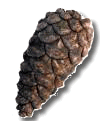
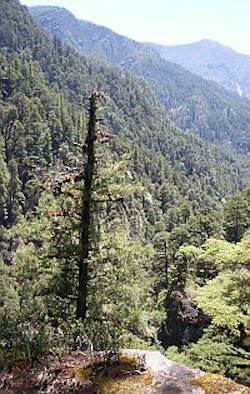
The Boreal Forest is the term applied to the huge area of dense coniferous forests of North America, northern Europe and Asia occurring at high latitudes where the climate is characterised by very cold winters, usually about 40cm of rainfall and a short summer growing season. The dominant species are evergreens, such as pine, spruce, fir, whose water loss through transpiration is low in winter at the time when the soils may be permanently frozen.
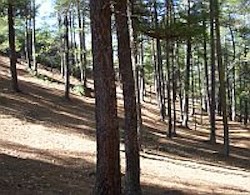 Unlike tropical forests which have a huge range of species, the boreal forest usually have rather few species of trees, shrubs and plants. In fact the undergrowth of boreal forests is almost non-existent. The species present are able to get their nutrient requirements from the very shallow layer of soil above the permafrost. The trees present have a notable climatic tolerance and survive on rather infertile soils. Pines survive on very sandy soils like those in northern Europe whereas spruce requires more loamy and clayey soils with more nutrients.
 Most of the soils are strongly leached as a result of centuries of leaching and somewhat impoverished parent materials. The soils are generally strongly acid and the main soil process under this dominantly leaching climate is 'podzolisation' leading to podsolic soils. The extreme climate coupled with the strong soil acidity means that relatively few organisms exist in the soil and the turnover of organic matter is slow.
Under these conditions the organic layer comprising the topsoil is usually thick and consists of a litter layer (L) (largely undecomposed), overlying a fermentation layer (F) in which there is some decomposition of the organic remains, and this in turn overlies a humose layer (H) in which decomposition of the organic remains is more or less complete. The turnover of plant remains into nutrients that can be re-used by the trees is very slow here, and is in strong contrast with the rapid turnover experienced in the tropical rainforest.
Below these layers is the strongly leached subsoil and other layers rich in organic matter and iron washed down from higher in the soil profile. Many conifers exist on very low quantities of nutrients and hence can just about survive on these very nutrient-poor, leached soils.
The boreal forest-soil relationship is another example of the strong adaptation that exists in nature between the nature of the soil, the vegetation that grows on it, and the prevailing climate. Again, it is a very good example of the nature's cycling and the precarious but successful relationship that exists between the soil and the forest.The soil thus plays a crucial part in forest production. There is a strong but often fragile link between the needs of the tree and the ability of the soil to satisfy them. Natural processes manage these linkages well, humans much less so!