
Desertification
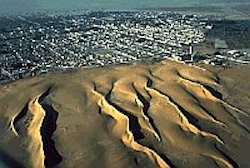
The world's great deserts were formed by natural processes over a long period of time and a study of fossil pollen in the Sahara shows how, over the centuries, the land can change between desert and fertile savanna. Such changes are chiefly the result of differing rainfall patterns and of human activities.
Desertification is the change in arid and semi-arid regions from formerly productive land to desert. It can occur all round the world, and not just on the edges of existing deserts.
The causes of desertification
In modern times there has been a great increase in desertification. The many and complex causes include increasing populations and the need to graze animals and grow crops. Over-grazing can be a great problem. Herds of animals also compact the soil, making water less able to penetrate so that the dry soil is more likely to be eroded by the wind. When the soil surface is dug for the growing of crops, this also makes the land more vulnerable to wind erosion. Such problems are particularly likely to happen in the fragile transition zones around the edges of deserts, but can also happen elsewhere if the conditions are applicable. A well-known example was the creation in the 1930s of the 'Dust Bowl' in the American mid-west, which was caused by drought and poor farming practices. Many people were forced to abandon their farms and livelihoods.The climate is clearly a factor, but droughts are not necessarily in themselves a cause. Well-managed lands can recover when the rains return, but if the land is mis-used during periods of drought, then this can made the situation worse. An example of this would be if nomads move during a period of drought to a less arid area, they and their flocks could upset the eco-system there and cause further deterioration of the soil. Rainfall is linked to some extent with plant cover and if this is lost then it may cause a decrease in the rainfall of the area.The fewer plants there are, the more impact the strong winds will have, with little to break their destructive force. Fewer plants also mean less shade, so that evaporation increases, bringing salts up to the surface. This salination means that some plants will be unable to survive, causing further evaporation to occur. So the cycle of desertification continues.Off-road vehicles can destroy in moments soils which have taken years to develop.
What can be done?
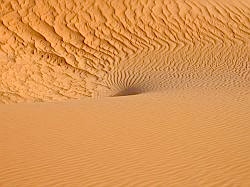 With climate change likely to disrupt rainfall patterns, the problems are likely to intensify. We need to try to understand the causes better, so that we can improve the situation. At a local level it is possible to provide windbreaks of fencing or trees belts and in some areas grids of straw have been laid, with shrubs planted in the straw, to provide some protection from evaporation and wind.
Better farming methods are needed, with the best possible use made of existing water resources and the control of salinization. Irrigation can help if there is enough water available. A suitable rotation of crops must be introduced, enabling the fragile soil to be protected. Most important is the need to educate the people into how to manage their local area.