
Soil and infrastructure
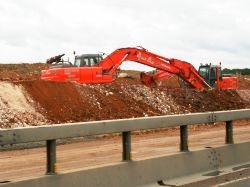
The main properties of soil important for supporting buildings, roads and other parts of the infrastructure are it's physical ones. Design of the foundations of buildings and other constructions must take into account soil properties and behaviour. Composition and texture of the soil, mineralogy of its clay component, its soil structure and its chemistry are all fundamental properties which need to be understood well. Organic soils, such as peats, are totally unsuitable for building on because they have a very low bearing capacity and are very prone to shrinkage.
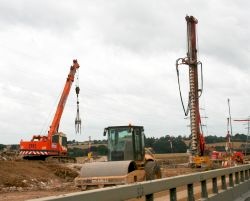 Soils that are dominantly clayey need to be assessed carefully. This is because some minerals in clay soils are noted for their capacity to shrink when dry and swell when wet. Such soils are fairly common worldwide and special techniques need to be used when building on and in them because of the marked differences in the strength of the soils between wet and dry conditions. Sandy soils, in which the grains are more or less in direct contact with each other, generally have a strong bearing capacity and can form stable foundations for buildings.
Soils with a mixture of particles (loams) can also have a reasonable bearing capacity because the different sizes of particle mean that there can be more cohesiveness. Some soils contain chemically reactive minerals, for example gypsum and other sulphates, which can lead to rapid decomposition of some foundation materials.  This extraordinary photo shows a house built on shrinking East Anglian peats. As the fen was drained the peat shrunk dramatically, leaving the house 'up in the air'. Just look at the height of the wall around the house and the steps down to the current soil level! Peat can shrink by several metres due to drainage - it just goes to show how much of the soil is made up of water.It is now widely accepted that it is important to carry out description and measurements of soils to check their suitability for building purposes. Requirements in this respect include a measure of the soil's consistency, that is the extent to which a soil resists deformation when a force is applied. One of the most important soil measurements is soil strength, which describes the ability of the soil to withstand stresses. In particular the engineer will need to know how well the soil resists rupturing and deformation, and how and under what stresses the soils are likely to do this. There is a need to calculate the bearing capacity of soils under shallow and deep foundations. In the case of clay soils it is advisable to identify their shrink-swell potential. These are the sorts of measurements that civil engineers use to try to ensure safe constructions.