
The main soils of Britain
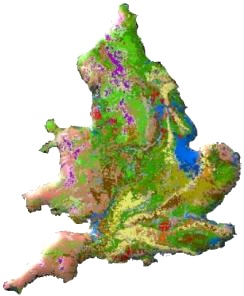
There are two main soil groups covering over 60 per cent of the country. These are 'brown earths' and 'gley' soils. In many ways the brown earths can be considered as the type soil to form under the temperate climate of Britain. Brown earths are generally well or moderately well drained soils, moderately deep (usually 50-150 cm deep) with brownish horizons below the topsoil. The brownish horizons result from the weathering and release of iron oxides in the temperate climate.
Data sheet:
The soil map and soil classification in England and Wales
Gley soils are soils which are periodically waterlogged. There are two main types of gley soil: surface water gley and ground water gley. Surface water gley soils are formed in slowly permeable sediments such as clay strata from several of the geological periods or in clayey glacial deposits left at the end of the last Ice Age. The key feature of the soils is that their B horizon is quite compact and contains few large pores when moist. When it rains, particularly in winter, there is often more water entering the soil than there are pores capable of transporting it through the soil and the soil becomes anaerobic. This leads to waterlogging in the soil and a consequent lack of aeration. The groundwater gley, by comparison, occurs on sediments in low lying areas, such as river floodplains. Here during the winter and spring the water table rises up into the soil and floods the soil horizons. This process also leads to the soil being periodically anaerobic with grey colours and occasional mottles of reddish/brownish iron oxide as evidence. In addition to these two extensive types of gley soil, there is also the less extensive unripened gley soil formed on land that is regularly flooded by water, such as tidal sea and brackish water.
Another distinctive soil of Britain is the Podzol. These soils are formed on lighter textured material like sands and gravels, under coniferous forest and heathland. They are generally strongly acid and normally well drained. Under the acid conditions there is build up of organic remains at the surface. Rainwater reaching the soil becomes acidified and is able to leach some of the nutrients and transfer them from the upper to the lower parts of the soil profile. The soils thus have dark brown or black surface layer, below which is a whitish bleached horizon from which nutrients have been washed out, then further down are layers where organic matter, iron and aluminium washed down from above are redeposited. It is one of the more colourful and distinctive soil profiles of Britain.