
Human soil compaction
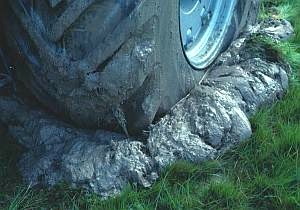
This is the best known form of compaction and the one that causes most concern. It is mostly related to agricultural practice but occurs also during the cutting down of forests and sometimes during the building of the nation's infrastructure. Since World War II, in particular, there has been a drive to increase agricultural productivity, brought on by the concern that there would be food shortages. This has led to what is referred to as 'intensification of farming', aimed at producing improved crop yields. It has led to a number of changes in the way land is managed for crop production. Firstly, there has been a huge change in the way we cultivate land. Compare, for example, the pre-war horse and hand-held plough system with the modern-day tractor, which can weigh more that 20 tonnes, and the multishare plough. The physical pressure put on the soil is so much greater now and this has contributed to compaction, particularly of silty and clayey soils.
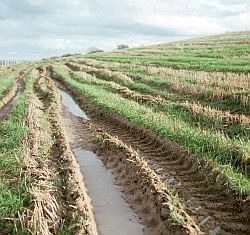 Not only has the weight of vehicles increased but the number of treatments made to a field to produce crops has also increased. Thus a field planted for wheat may now, during the period up to harvest, be ploughed, cultivated to produce a reasonable seed bed, drilled to add the seed to the soil, spread with fertilizers, and sprayed with weedkillers one or more times. There can now be around seven separate traffickings made to a field to produce a crop of wheat. If these are carried out on silty or clayey soils when they are wet and as a result the strength of the soil is reduced, the soils are likely to become compacted. In the 1960s, 70s and 80s, the soils of many fields became extensively compacted and developed plough pans (zones of compacted soil beneath the topsoil as a result of the weight of the equipment, the poor soil structure and the wet conditions). Now the problem is better understood and more care is taken to avoid compaction but it is still a problem on some farms. Compaction can also occur under farm animals, particularly where large numbers of animals graze fields when soil conditions are wet.
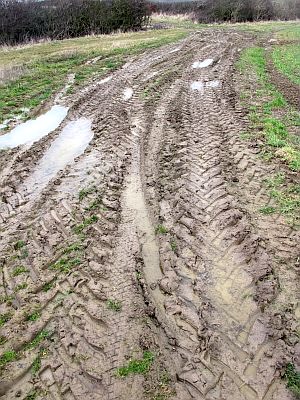 Although intensive agriculture has been one of the main reasons for compaction, deforestation has also led to a great deal of compaction. The machinery used now to fell trees and particularly to remove the trees from the site is large and likely to be used in a wide range of weather conditions, some of which lead to extensive compaction. There is an additional risk involved in that many forests are on sloping land. Compaction of the soil prevents infiltration of rainwater which then runs over the surface causing soil erosion. In the tropics, such as the Amazon Basin, cutting down of the forest, with the compaction that it causes, has led to large scale erosion. In addition to agriculture and forestry, building of houses, roads, and other parts of the infrastructure can lead to compaction. In some cases this is encouraged so as to get a firmer base for the buildings and roads, in others it is an unwanted side effect which can interrupt the natural flow of water from one area to another and add to flooding risk.