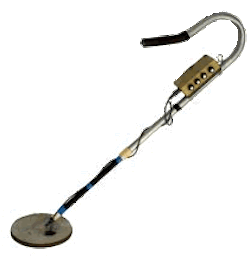
What is a metal detector?
Metal detectors are used to detect metallic objects buried in the soil. Metal detectors are often used by archaeologists and treasure hunters looking for things like coins, broaches, clips and even larger items such as parts from swords and helmets. Metal detectors are used widely by military engineers to look for buried mines.
How is a metal detector used?
The metal detector contains a detecting head, or coil, which is held close and parallel to the ground. The head is fixed to the end of a shaft, inside which are wires connecting the head to the control unit. The detector is hand-held, and the user is able to walk along sweeping the head backwards and forwards over the ground. The control unit outputs a signal, for instance a tone played through a speaker or headphones, or a reading on a meter. When the head passes over a buried metallic object the tone or signal varies to let the user know.
More advanced detectors have control units which can be 'tuned' to react to different types of metal, or object sizes. This could for instance allow the user to ignore drink can ring-pulls whilst identifying coins.
How does a metal detector work?
Inside the head is a long continuous coil of very thin insulated wire. Electric current is passed into the coil; this coil then transmits an electromagnetic field around the coil into the soil. The current flowing into this coil is pulsed rapidly, with the direction of the current being changed each time. This affects the 'polarity' of the electromagnetic fields. Metallic objects in the soil can affect this electromagnetic field (also called the 'EM' field, or EMF, for short). These differences are then detected by a second coil of thin wire inside the head. This coil is able to identify variation in the EM field. The nature of this variation can be interpreted to identify the size of the buried object and its conductivity. Since not all metals conduct electricity in the same way, the type of metal can be identified. Metals like gold and silver conduct really well - this allows hoards of gold coins to be found.
How do different soils affect metal detectors?
As described, the detector coil picks up differences in the EM field in the soil from metallic or conductive objects. However, soils can also contain traces of conductive ferrous minerals. Also salts in the soil water can affect the EM field - especially a problem if detecting on beach sands. The overall result of this is that the ground itself can give a signal that seems as if an object is buried. Most detectors therefore have a means to 'tune out' the effects of the ground - a 'ground balance' control or discriminator.