
The Somerset Levels
This area of northern and central Somerset is an internationally important area of wetland, hugely rich in plant and bird life. It stretches from the Mendip Hills south-west to the Quantocks and from the Severn Estuary to Ilchester, some 70,000 hectares in total.
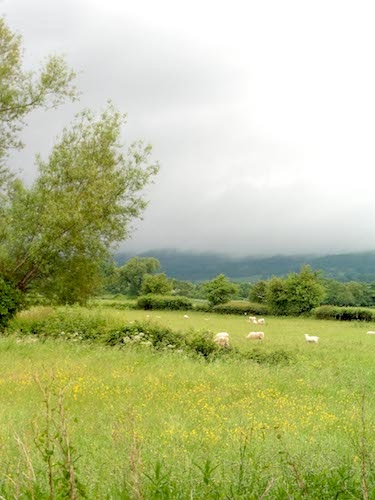 The landscape is flat and low-lying, with a maximum height about sea level of 8 metres. Many unexpected small hills rise from the plain and the area is criss-crossed with chanels which have been constructed to drain the land and to try to control flooding. A number of rivers cross the Levels, notably the Axe, Brue and Sheppey in the northern part and the Parrett, Tone, Yeo and Cary in the south. The soils are clay along the coast and peat marshes inland, and are mostly farmed as grassland with some arable, the floods, when they occur, providing rich silt deposits which enrich the soil. Today the area is typically farmed with open fields of permanent grass surrounded by ditches and willow trees. Willow is also grown commercially and there is a thriving industry in basket-making and other willow products near Athelney.
The history of the area
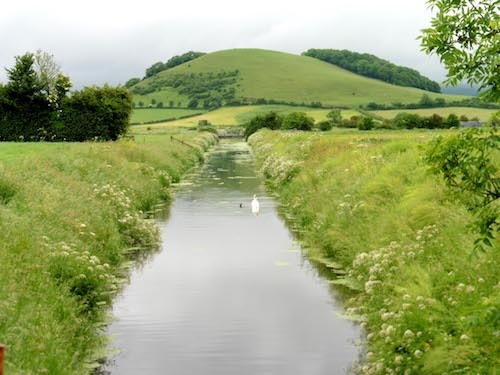 Long ago the area was covered by the sea, with many small islands standing above the water. A look at the Ordnance Survey map shows a number of early hill forts were established on the high ground of some of the many abruptly-rising hills, such as Brent Knoll and Banwell Camp. Much of the land in the Levels is below high water level at spring tides, but efforts have been made to drain this potentially rich farmland since Roman times. The Romans also extracted sea salt from their settlements in the Polden Hills. The monks of Glastonbury Abbey and Muchelney owned great areas and they carried out drainage schemes to create good agricultural land. Drainage has continued since, with Dutch engineers employed in the 17th century and the work continuing to this day. However, the area is still prone to flooding and most recently in 2014 some 10% of the area was flooded, causing huge damage.
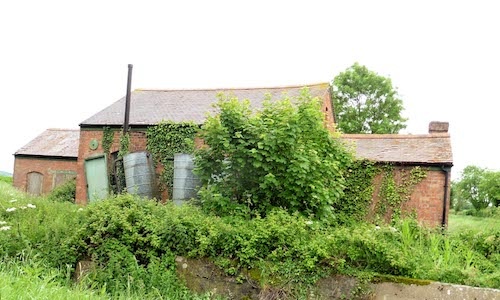 The peat is a perfect soil for preserving some of the fascinating history of the area, which has been populated for many hundreds of years, in spite of the mixed landscape of open water, bog, reedswamp and wet woodland. Several Iron Age artifi cial lake villages have been preserved. A foundation of timber, brushwood and clay was constructed, forming an 'island', known as a crannog, on to which houses and barns were built. As many as 200 people lived in the village near Glastonbury and there were 50 to 60 huts in each of the two villages found at Meare.These villages were linked by a number of ancient wooden trackways some of which date back 4,500 years. These have also been discovered preserved in peat, often when this was being cut for commercial use. The tracks had been formed by setting pairs of sharpened stakes into the soil to form a V-shape, to which planks were then attached as a pathway. The most important is the Sweet Track that ran from the island of Westhay to the dry land of the Polden ridge to the south. More information about thes tracks can be learned if you visit Shapwick Heath National Nature Reserve. Finds such as a hoard of bronze axes, which were probably offerings to the gods of the wetlands, deposited intentionally, have also been discovered, often beside the old trackways.
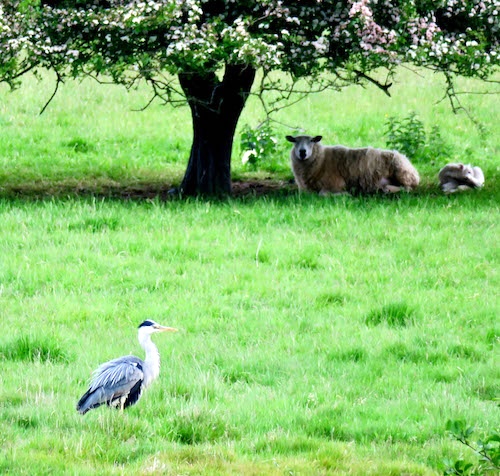
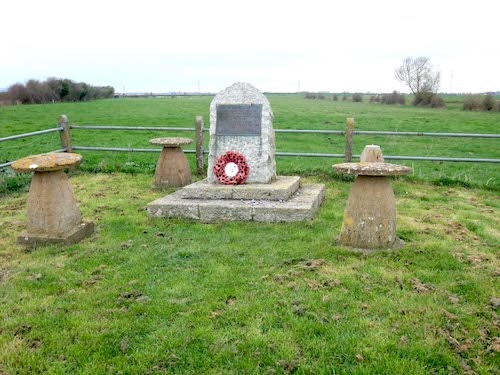 In more recent history the Levels are chiefly remembered for two episodes. It was at Athelney that the Saxon King Alfred took shelter before gathering an army and setting forth to defeat the Danes at Edington in 878AD. Another battle took place during the Civil War in 1685 actually in the Levels near Westonzoyland at the Battle of Sedgemoor.This rich habitat is world famous and contains a number of reserves and Sites of Special Scientific Interest, places where conservation is actively being carried out to preserve flora and fauna, and even to reintroduce species lost to the region, such as the common crane. The area is home to a wide range of plants and animals - such as this Grey Heron resting in a field next to its lake.
 References:
https://avalonmarshes.org www.digitaldigging.net Wikipedia