Badgers are native British mammals which appeal to many people. They are nocturnal, so are hard to see unless you wait up all night.
Badger (Meles meles) Image credit and copyright: John Howell.
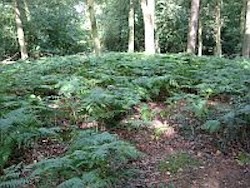
Hidden in the depths of this old woodland is a clearing where the sunlight penetrates to the floor of the wood. Thanks to the light, Bracken (Pteridium aquilinium) has sprung up, hiding what is below.
Who lives here?
This area, with light sandy soil is free-draining and easy to dig, was carefully chosen and is the home of the Badger (Meles meles), the much admired and largest of the underground dwellers in the UK.
The ideal badger habitat is open countryside where they build their setts, or homes, at the edge of woodland, in hedgerows and banks. Many setts have been inhabited for generations, maybe hundreds of years. In places where they now find themselves living in urban areas, this is due to man's incursions into their territory rather than because they are opportunist migrants into towns. Setts are often built in earth banks which provides good drainage. A large sett may have as many as 20 entrances and often includes smaller outlying setts. The badgers excavate tunnels which generally have a number of entrances. This allows both an escape route in times of danger and also provides a flow of air through the sett. Breeding chambers are built off these tunnels and rarely at the end of a single dead-end tunnel.
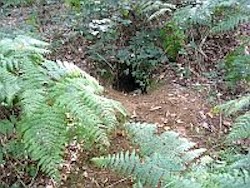
First tunnel entranceAll around this area, for a distance of 20 or so metres are a series of large tunnelled entrances. Inspection of these entrances reveals traces of the unmistakeable tough black tipped hair of the badger.
This active Badger home is called a 'Sett' and is the nerve centre of considerable night-time activity. As many as 15 Badgers may share a Sett - quite a community!
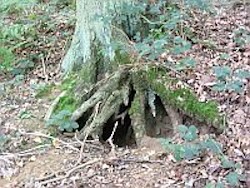
Second tunnel entranceDuring the day the Badger sleeps underground in one of a series of interconnected chambers and passages.
Seeing the Badger is not easy as they are rarely above ground during the day - but if you are lucky you can find evidence of their movements. The photo below shows a clear print in the soil.
At night, the Badger emerges to tread along well-worn paths leading off through the wood to the various hunting grounds. These animals are foragers, not hunters. In the open countryside their food consists largely of earthworms. However, they are omnivorous and eat fruit and also small mammals such as nestling rabbits, rats and sometimes even chickens. They have a strong sense of smell which is used in searching for food.
As housing development increasingly spreads across the countryside, some badgers find themselves living in an urban situation. They are a protected species and they and their setts may not be damaged. However their territories are not protected and so in towns they can become a nuisance as they have nowhere to go. It is not permitted to remove them to a new location, and in any case, since they are strictly territorial, they would resist a move.
Badgers have no natural predators except man. The conflict caused by setts in urban areas and disturbance by householders is a problem. Badgers have been accused of bringing tuberculosis to cattle - a case so far unproven - and this makes them unpopular with farmers in areas where TB is endemic. Road deaths account for some 50,000 animals a year.
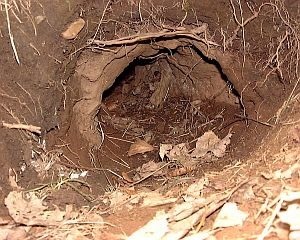
Sett entranceThe young cubs are usually born around January or February, though, since the females are able to delay implantation, they may be conceived at any time of year. One or two cubs are the norm, occasionally three, and births are more common in open countryside where food is not an issue. There is a high mortality among badgers, perhaps half of the cubs not reaching adulthood. Around ten years old is probably the maximum age reached in the wild, but the species continues to hold its own with regards numbers. They will continue to live as a family unit even when the cubs become adult. The size of their territory will depend on how many other badgers live in the area.