
Soil microbeasts
Here are some fantastic video clips of some soil micro-beasts. These give a really good idea of the diversity of life in the soil. These beasts are so small they can barely be seen by eye, so these videos were made using a magnifying video camera. The clips are provided in both AVI and MPG format and are large files!
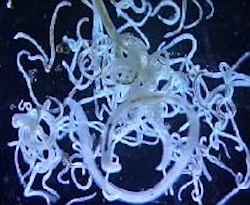
Enchytraeids (common name: potworms) are related to Earthworms. Enchytraeids are small (10-55 mm long) unpigmented worms. Enchytraeids eat both mineral and organic material in the soil, including soil fungi and bacteria found in this material. Enchytraeids can be found across a broad range of ecosystems, but their population densities vary according to the ecosystem type. For example they are far more abundant in acidic heathland soils compared to agricultural soils.
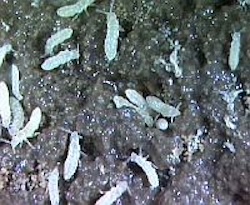
Collembola (common name: springtails) are small (0.2 - 10 mm long) wingless insects that are the 2nd most abundant microarthropod group in soils. The name springtail was given as the majority of species have a spring underneath their abdomen that allows them to jump. Most species live for less than 1 year. They feed on fungi and decomposing plant material. They live in the soils of most ecosystems of the world, with population abundances are often in excess of 20,000 m2.
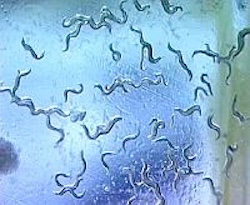
Nematodes (common name: roundworms) are microscopic in size (~ 1 mm long). They are the most numerous multicellular organism to be found in the soil, with average densities of 5 - 10 million m2.They live in water films between soil particles. They feed on a wide range of foods, which include bacteria, fungi, plants, other nematodes etc. They help with cycling of nutrients in the soil.
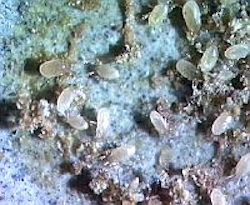
Hypoaspis: Acari (common name: mites) are related to Spiders. They are small (adults 0.1-30 mm long) arthropods, and are the most abundant microarthropods found in most soil types, with densities as high as 1 million m2. Acari feed on a range of food sources; plants, fungi, microorganisms, or as parasites or predators. They help with the breakdown of organic material and cycling of nutrients in the soil.
If you wish to find out more about these amazing creatures, here are two book references:
Coleman, D.C., Crossley Jr., D.A. and Hendrix, P.F., (2004). Fundamentals of Soil Ecology. Elsevier Academic Press, Athens.
Bardgett, R. (2005). The Biology of Soil. A community and ecosystem approach. Oxford University Press Inc., New York.
Video clips taken by Paul Chamberlain, and are used by kind permission of the Centre for Ecology and Hydrology