Turkish Hoyuks
In the early Neolithic period in Anatolia, modern Turkey, starting some 12,000 years ago, hunter-gatherers began to settle in permanent village communities. They learned to farm crops and to keep domesticated herds of sheep, goats, pigs and cattle.
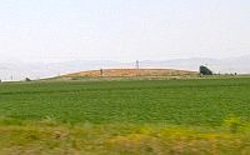 Around the Anatolian Plateau in Turkey can be found many hoyuks dating back to the Neolithic period. A hoyuk is a high mound of earth formed by thousands of years of human habitation on the same spot in buildings constructed of mud bricks. These bricks have a lifetime of some 60-70 years and, over the centuries, were levelled as they fell into disrepair, a new home being constructed on top. This led to the hoyuks growth of approximately a metre a century, 50cm per rebuild. During levelling, the walls were collapsed inwards into the living space, so that a portion of the wall was left standing.
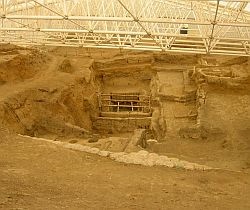 A number of these hoyuks have been excavated by archaeologists, who have found that the soil has preserved an immense amount of information as well as wonderful artefacts, each layer representing a unique history of the past. Many small items can be seen on the surface and these are not necessarily only from the topmost levels - due to soil disturbance caused by the custom of burying the dead under the floors, of digging pit latrines etc, small artefacts from lower levels can sometimes work their way right to the surface.
A Case Study
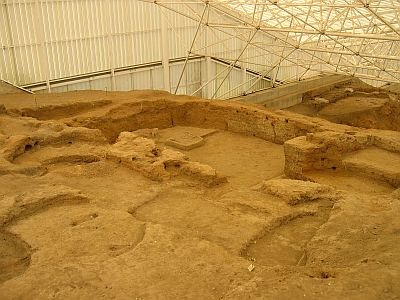
Çatalhoyük (pronounced Chatalhoyuk) is an important site on the Konya Plain in southern central Turkey - located 34km SE of Konya, near the town of Cumra with two further mounds near the village of Kucukkoy, 10km from Cumra. It dates from around 9,000 years ago and may have had a population of as many as 8,000 people. Occupation on the main mound lasted for about 1,400 years and then moved to a smaller mound to the west. This was the period when people were gradually changing from being roaming hunter gatherers and beginning to settle in communities, archaeological finds showing that they were living by a mixture of farming and hunting.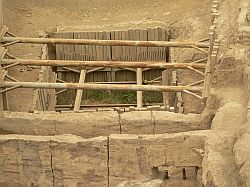 The site was investigated first in the 1960s by a British archaeologist, James Mellaart, who excavated the mound, finding thirteen occupation levels. Work was restarted in 1993 by an international team led by Ian Hodder, who decided additionally to uncover another house and study it in greater detail, helped by newer techniques. A number of other studies are also being carried out under Hodder's direction. This is a world-famous site and is providing us with a lot of new information about the early Neolithic period. The main excavation areas are now roofed over to preserve the buildings and allow public access.
What has been found?
Bulls heads modelled around real skulls have been found decorating some of the rooms, also clay figurines. Dramatic wall paintings in red and black on a mud-plaster coating show hunting scenes, rituals and geometric patterns.Tools and weapons made from obsidian, a volcanic "glass", have been found, bone tools and clay stamp seals and pots. Many items are now displayed in the Museum of Anatolian Civilisation in Ankara.
What has been learned?
Much has been learned about the lives lived by the inhabitants of Çatalhoyük. The houses were built very close together, with no doors or windows. There were no streets and access was through the roof, so that much of the life of the town took place at rooftop level. Enough remains of the walls and roofing material to understand how the buildings were constructed and roofed. Hearths and raised sleeping areas can be seen and some pieces of matting plaited from wild grasses have been found. Clay bins to store foodstuffs survive. Today's scientific techniques are able to give us much information about all aspects of daily life.We have learned of the burial customs of the time. Many burials took place under the floor of the houses. Young people often had grave goods interred with them and babies were placed in reed baskets. The skeletons were found in a crouched position.
We have evidence of a difference in the climate at that time. It was wetter than now, causing marshes to form, so that reeds and mud were plentiful. The climate also meant there was plenty of wild grain and animals for food.
Timber and plant remains can be carbon-dated to give a date for the settlement.The preservation in the soil of so much evidence has given us new insights into life in Anatolia in the early days of settled community life. There is still much to discover and the project at Çatal is likely to continue for many years.