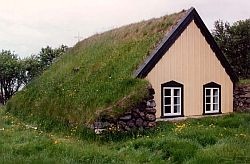
Turf walls and roofs in Iceland
Turf has good insulating properties and in a country such as Iceland, where there are very few large trees. It was used extensively for roofing and even for walls in many rural houses and outhouses until about 1900. Many of the best remaining examples have been renovated and turned into museums, but as one travels around, one can still see turf roofs on sheds and occasional houses.
Glaumbaer Museum is a restored farm consisting of two rows of rooms with a central passageway linking them. The buildings date from slightly different periods in the 18th and 19th centuries. The thick walls are all constructed of turf, with a thin lining of imported timber. The timber-lined roofs, too, are a thick layer of turf, with thick-rooted grass - and wild flowers - growing on the surface. Such a building can last for a hundred years if properly built - the roof must be at the right angle - if it is too flat the rain will leak through and 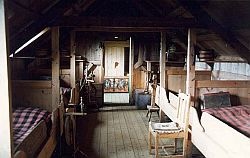 if it is too shallow the grass drains too quickly and will not grow properly, so that again, the water will leak through.
It is difficult to build large structures of turf, so Glaumbaer is typical of old Icelandic farms in being a complex of small buildings, joined side to side for maximum insulation during the bitterly cold winters. Just the gable ends are of wood. The smell of the turf walls inside the house is lovely.
Turf-roofed churches
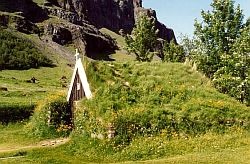 There are still several churches with turf roofs to be seen in Iceland, as at Hof and Nupsstadir, with buttercups and dandelions growing all over the roof. The Hof church was built on the foundations of a temple to Thor.These turf-roofed buildings fit into the landscape in a way that houses of modern building materials never can. It is very good that some of the remaining buildings are being preserved.