
Kerkenes Dag, central Turkey
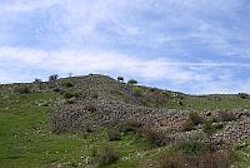
This case study explains how a major archaeological investigation is being carried out in the ancient city of Kerkenes Dag in the Republic of Turkey. Here the soil has acted to protect and preserve the building structures and artefacts from the city for hundreds of years and is now revealing the secrets of the past.
Kerkenes could be described as a lost Iron Age city, occupying most of a low mountaintop in central Turkey. Since 1993 it has become a major project for a team from the British Institute of Archaeology in Ankara, led by Dr Geoff Summers.
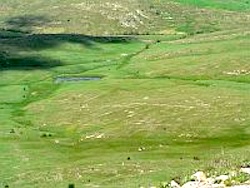 The city has been valuable to study because it is known that it was destroyed by fire just some 60 years after it was built, so that it provides an excellent snapshot of a city of its period. No other city stood on the site, either before or afterwards. The soil cover there is now thin and even with the naked eye it is possible to see the outlines of many buildings. The remains of the city wall, 7 kilometres long and with 7 gates, are clearly visible around this huge site and were built so as to include several natural springs within the strongly-fortified city. It appears to date from the 7th century BC.
How has it been studied?
It was determined to study the site by non-invasive means of archaeology as much as possible, since it is believed that "All excavation is destruction". Therefore a satellite image was studied first, covering an area of 40km by 40km around Kerkenes. The results were placed over a digitised map, which clearly shows the relationship between the clearly-defined city wall and the surrounding landscape. Next the site was photographed from a tethered balloon and these results were laid over GPS data taken during a survey at ground level. A geophysical survey followed, giving excellent geomagnetic results, so that by the end of 2001 the entire city site except the steepest part of the Kale, or citadel, had been mapped on computers. This was done together with a resistivity survey where the ground was suitable, carrying out successful experiments with electrical conductivity while the site was damp. These results are so clear at Kerkenes for many reasons; the granitic bed-rock and soils, the single period of construction with no later superimposition of buildings, the closeness of wall tops to the modern soil surface and the destruction of the city by fire. All these tests have provided a remarkably-detailed picture of almost the entire city, which were proved to have pin-point accuracy when checked by the digging of a few test trenches.Hands-on work
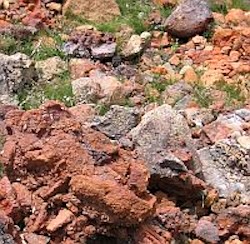 The test trenches were dug to ascertain the accuracy of the remote sensing techniques. A limited amount of investigation has begun with the clearing of debris from around parts of the wall, exposing the Cappadocian gateway and also what is thought to be a palace complex with a monumental entrance. Dramatic evidence has been uncovered here which shows how a ferocious fire started here which destroyed the "palace" gateway. The fire was so hot that it melted the rocks there! The discolourations in the rocks can be seen today as this photo shows.
What has been discovered?
The density of the city building shows a high level of centralised planning and construction, with a huge workforce. This was clearly the centre of a very powerful state. Architectural elements, relief sculpture, inscriptions, small finds and pottery all show that the destruction by fire must have occurred around the mid 6th century BC. This suggests it can be identified with the city named Pteria laid waste by Croesus, King of Lydia, in around 547BC. Military works were still in progress when the city was destroyed and there is little evidence for a large civilian population.Evidence found in the soil wherever it has been studied shows that the fire was deliberate and widespread. Much of the city was intentionally toppled and destroyed before being torched. Many of the buildings had stone footings with timber frames infilled with mud bricks above, so they would have burned fiercely.
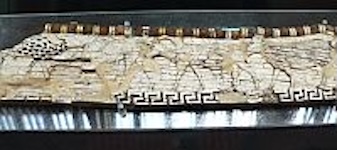 Among the special finds is a carved ivory plaque, possibly an inlay from a piece of furniture and depicting two sheep, two goats and a deer: this piece is now in the Museum of Anatolian Civilisation in Ankara. Another find, smashed into many pieces and which is now being gradually reassembled, is a carved stone statue which was found buried in a guardroom close to the Cappadocian Gate.