
Peat and archaeology
Bog bodies and buried treasure
Peat is a type of soil made up of waterlogged partially-decomposed plant material including sphagnum moss and other acid-loving plants. It has built up over something like 8-10,000 years in poorly-drained wetland habitats.Bog bodies
Peat has proved to be very valuable for preserving many aspects of the life of former cultures, which modern science is able to interpret in considerable detail. Bogs preserve items which fell or were buried in them thousands of years ago. From time to time during peat extraction activities, human remains have been recovered. These are able to teach us a great deal about the bodies, since the peat preserves not just the skin, hair and skeleton, but even the stomach contents (so we can tell what people used to eat). The colour, weave and fabric of clothing can be seen as, sometimes, can the means of death. It is possible to carbon date such items, which gives a reasonably accurate date of death.Lindow Man
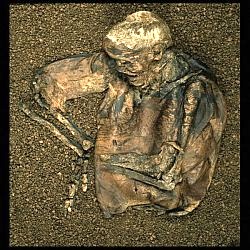 A famous bog body - which you can go and visit in the British Museum - was found at Lindow Moss, near Manchester. He has been named Lindow Man and died about two thousand years ago at about the time the Romans were invading Britain. He hadn't died by accident. He had been hit three times on the head, had his throat cut and then a rope tightened around his neck. He appears to have been thrown into the bog, perhaps as an offering to the Celtic gods. British Museum Compass site Mummytombs
Other peat bog finds
Other finds in peat bogs have included jewellery, weapons, tools, household utensils and vessels. Wood is often well preserved and the remains have even been found of timber trackways which were constructed across the marshland hundreds of years ago. The wood can be dated by radio carbon technology. Even log boats have been found, the earliest in Ireland being over 7,000 years old. Sometimes megalithic tombs and stone circles were covered by growing peat bogs, and some of these are being uncovered as peat extraction is carried out. It has even been possible to study field layouts from Neolithic farming which took place on land later covered by peat bog.Lindow Man image © Copyrights the Trustees of The British Museum